FOUNDATIONS OF VISION
A Tour of Your Vision
When you see, you’re not really “seeing” with your eyes—you’re seeing with your brain. Your eyes collect light and send it on a journey full of fascinating steps before your brain turns it into what you experience as vision. Let’s break it down.
Step 1: Light Enters the Eye
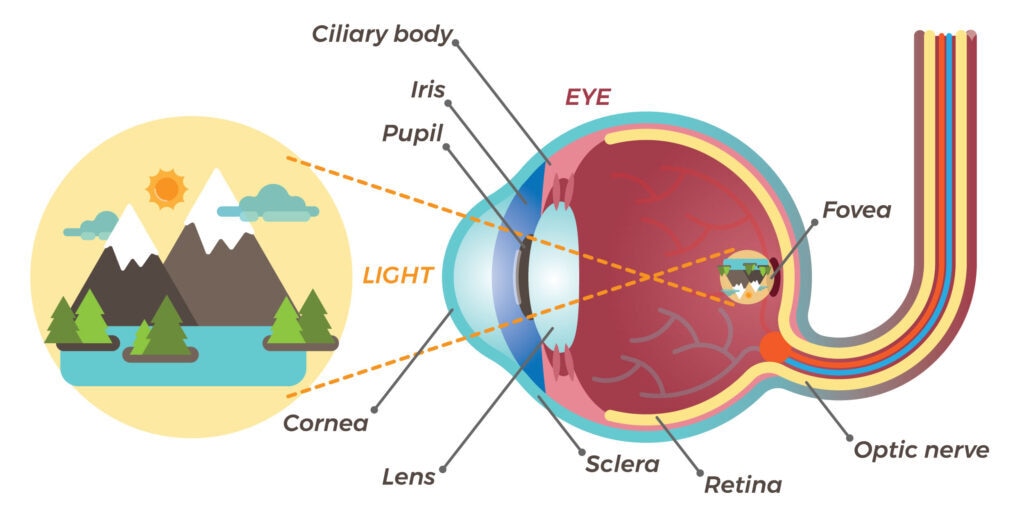
Light from the world enters through the cornea, passes through the lens, moves through the fluid in your eye, flips upside down, and lands on the retina at the back. This is your eye’s built-in camera.
What If the Image Isn’t Clear?
When your cornea and lens don’t focus perfectly, the image on your retina is blurry. Glasses or contact lenses add a third lens that works with your natural lenses to refocus the light perfectly onto the retina.
Your lens works like a camera’s autofocus. When you’re young, it flexes easily so you can see up close and far away. Over age 40, that lens stiffens, making reading glasses necessary; this is called presbyopia.
Step 2: Down the Optic Nerve
Once the light is turned into electrical signals on the retina, it travels down the optic nerves. There is a fascinating twist at a junction called the optic chiasm:
- Left Visual World: This information goes to the right side of your brain.
- Right Visual World: This information goes to the left side of your brain.
Step 3: The Thalamus - A Secret Data Drop
The next stop is the thalamus, also called the lateral geniculate nucleus. About one-third of all visual information never makes it to your “seeing” brain. Instead, it goes to parts of your brain that control balance and movement.
Try standing on one foot and then close your eyes. Balance becomes much harder because you lose the visual input that quietly helps you stay upright.
Step 4: The Visual Cortex - Where Seeing Happens
Finally, the rest of your visual data reaches the visual cortex at the back of your brain. This is where you truly see. This explains why someone can have “perfect” 20/20 eyesight but still struggle with processing. A brain injury or other condition can break down vision even after the eyes have done their job.
The Big Takeaway
Your eyes gather light, but your brain does the heavy lifting. Seeing is never just about clear images on the retina; it is about how your whole visual system—eyes, optic nerves, thalamus, and cortex—work together.
Do you have a question about how your brain processes what you see?